
How Technology Is Supporting Special Education Staffing
News • Posted 04.15.2026
Special education staffing has always required a highly personalized, consistent, and responsive approach. Schools must ensure that students with diverse learning needs receive continuous support, even in the face of staffing shortages, geographic limitations, or sudden absences. Technology is increasingly supporting special education staffing by making it easier to recruit, deploy, and manage qualified professionals.
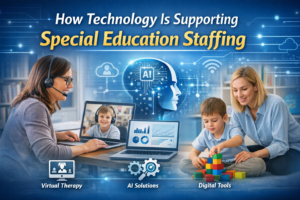 Today, technology is playing a critical role in bridging these gaps. From virtual therapy platforms to AI-driven scheduling systems, digital tools are helping schools and staffing partners deliver more reliable and effective special education services.
1. How Digital Platforms Support Special Education Staffing Efficiency
One of the biggest challenges in special education is quickly filling specialized roles such as special education teachers, paraprofessionals, and therapists. Modern staffing platforms now streamline this process through automation and centralized databases.
Key benefits:
- Faster candidate matching based on certifications and experience
- Automated credential verification
- Real-time availability tracking
- Reduced administrative workload for school districts
Many staffing agencies also use applicant tracking systems (ATS) to maintain a ready pool of qualified professionals, improving special education staffing efficiency and reducing placement delays.
📌 Related reading: Why AI-Enabled Staffing Is Winning: What Employers & Job Seekers Need to Know
2. Virtual Support Expands Special Education Staffing Access
Teletherapy and virtual instruction have become essential components of special education staffing support. These tools allow students to access services even when specialists are not physically available in their district.
Common virtual supports include:
- Speech-language teletherapy
- Remote occupational therapy sessions
- Virtual behavioral consultations
- Online special education instruction and tutoring
According to the U.S. Department of Education, the use of educational technology has expanded access to services for students with disabilities, especially in rural and underserved areas.
🔗 External source: https://www.ed.gov
This model helps staffing agencies deploy specialists more efficiently across multiple districts without compromising service quality.
3. Collaboration Tools Improve Special Education Staffing Communication
Effective special education staffing depends on strong communication between teachers, therapists, administrators, and families. Collaboration tools have made this much easier.
Popular tools include:
- Microsoft Teams and Google Workspace for Education
- Secure messaging platforms for IEP coordination
- Shared digital IEP documentation systems
- Video conferencing for multidisciplinary team meetings
These tools ensure that Individualized Education Programs (IEPs) are consistently updated and followed, even when staff members are remote or working across multiple locations.
📌 Related reading: Ensuring Continuity of Care in Special Education Staffing
4. Data-Driven Insights Strengthen Special Education Staffing Outcomes
Technology is also improving how schools track student progress and optimize special education staffing outcomes. Digital IEP systems and analytics dashboards allow educators to monitor performance in real time.
Benefits include:
- Early identification of learning gaps
- Data-backed intervention strategies
- Improved reporting for compliance requirements
- Better alignment between staff performance and student outcomes
Organizations like CAST (Center for Applied Special Technology) emphasize the importance of Universal Design for Learning (UDL), which leverages digital tools to support individualized instruction.
🔗 External source: https://www.cast.org
5. AI and Automation Enhance Special Education Staffing Support
Artificial intelligence is increasingly being used to support special education staffing operations behind the scenes.
Examples include:
- Predictive staffing models based on historical demand
- Automated candidate screening
- Smart scheduling systems that reduce coverage gaps
- Chatbots for onboarding and applicant support
While AI does not replace human expertise in special education, it significantly reduces administrative delays—allowing educators to focus more on students.
6. E-Learning Supports Special Education Staffing Development
Continuous training is essential in special education staffing. Online learning platforms now make it easier for staff to stay certified and updated on best practices.
Advantages of e-learning:
- Flexible, self-paced training modules
- Access to nationally recognized certifications
- Consistent training across multiple school districts
- Reduced travel and training costs
The International Society for Technology in Education (ISTE) supports ongoing digital learning for educators to improve instructional quality.
🔗 External source: https://www.iste.org
Conclusion
Technology is reshaping how special education staffing works, from recruitment and placement to classroom support and student progress tracking. Digital tools and virtual services are not replacing educators; instead, they are empowering them to deliver more consistent, accessible, and effective support to students who need it most.
For staffing agencies and school districts alike, embracing these technologies is no longer optional; it’s essential for ensuring continuity of care and improving educational outcomes.
Share This Article